Inside the Approval Pipeline: Factors That Determine Transaction Success Rates at Secure Gaming Venues
Written by Sage Butler · Jun 14, 2026
Inside the Approval Pipeline: Factors That Determine Transaction Success Rates at Secure Gaming Venues
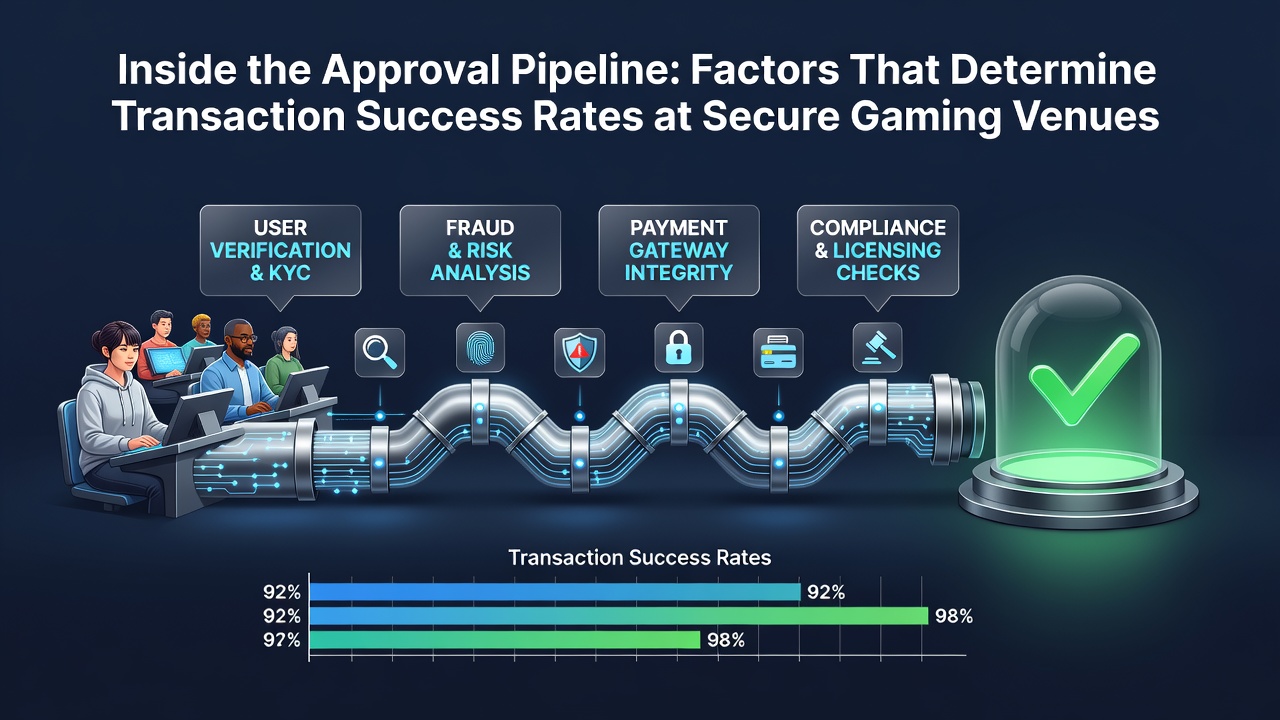
Transaction approvals at secure gaming venues depend on multiple interconnected stages that process deposits and withdrawals through verification layers, risk assessment protocols, and compliance checks before funds move successfully, and data from industry monitoring shows these pipelines handle millions of operations each month across licensed operators in various jurisdictions.
Core Components of the Approval Pipeline
Every transaction enters a sequence beginning with initial capture, followed by automated screening that flags anomalies based on predefined thresholds for amount, frequency, and account history, while subsequent manual reviews occur when algorithms detect patterns that require human oversight according to reports from regulatory bodies like the Nevada Gaming Control Board. Observers note that success rates improve when venues integrate real-time data feeds from payment processors, because these connections allow immediate cross-referencing against watchlists and previous activity records maintained by financial institutions.
Payment method selection plays a measurable role in outcomes, since credit card transactions often pass through additional bank-level authorizations that can reject or delay processing if velocity limits are exceeded, whereas e-wallet transfers tend to clear faster when the originating account has completed prior verification steps.
Verification and Compliance Factors
Know-your-customer protocols form a central gate, requiring users to submit identification documents that venues validate against government databases, and studies conducted by academic researchers at institutions in Australia reveal that incomplete submissions account for a significant portion of initial failures while complete files processed within standard timeframes show approval rates exceeding 95 percent in controlled samples. Venues operating under frameworks established by bodies such as the Alcohol and Gaming Commission of Ontario apply tiered verification that escalates based on transaction size, which helps maintain high success metrics without unnecessary friction for smaller routine transfers.
Regulatory updates introduced in several regions during June 2026 emphasized enhanced monitoring for high-value movements, prompting operators to refine their automated rulesets so that flagged items receive quicker secondary checks and overall pipeline throughput remains stable.

Technical and Operational Influences
System uptime and integration quality between gaming platforms and external payment gateways directly affect completion percentages, because even minor latency in API responses can trigger timeouts that force resubmission and lower measured success, while robust infrastructure maintained by large operators demonstrates consistent performance across peak hours. Research published through the Canadian Gaming Association highlights correlations between software update cycles and temporary dips in approval efficiency, noting that venues scheduling maintenance during low-volume periods experience fewer disruptions.
Account-level variables such as deposit frequency and historical cashout patterns also feed into risk models, and those who've analyzed aggregated venue data find that users with steady activity profiles encounter fewer holds compared with new accounts or those showing sudden spikes, which prompts the system to apply extra scrutiny until patterns stabilize.
External Data Sources and Regional Variations
Geographic differences emerge when comparing approval statistics across markets, since European operators following directives from national authorities in countries like Malta apply distinct documentation standards that sometimes extend processing windows yet yield high final success once requirements are met, whereas North American sites often prioritize speed through pre-approved player lists built over time. One analysis from the Australian Institute of Criminology examined transaction logs spanning multiple years and identified that consistent application of these layered checks reduces fraud-related declines without broadly suppressing legitimate volume.
Industry reports further indicate that collaboration between venues and payment providers has produced shared intelligence platforms that update risk parameters dynamically, allowing the pipeline to adapt to emerging patterns observed in real time rather than relying solely on static rules.
Conclusion
Success rates at secure gaming venues ultimately reflect the combined effectiveness of verification sequences, technical reliability, and adherence to evolving compliance expectations, and venues that align these elements consistently record stronger throughput according to available performance metrics. Continued refinement of these processes supports both operational efficiency and regulatory alignment across different regions.